Rotary table bearing
Rotary table bearings are rolling bearings for combined loads and are available in various designs and variants. Rotary table bearings are ready-to-install precision bearings for applications with high precision and combined loads.
Rotary table bearings in the form of axial-radial bearings or axial angular contact ball bearings absorb tilting moments without play and are therefore suitable for bearings with high requirements for running accuracy.
When selecting the right bearing, the application must be considered very carefully. The following distinguishing features between axial-radial bearings and axial angular contact ball bearings help as a rough guide:
Rotary table bearings - series
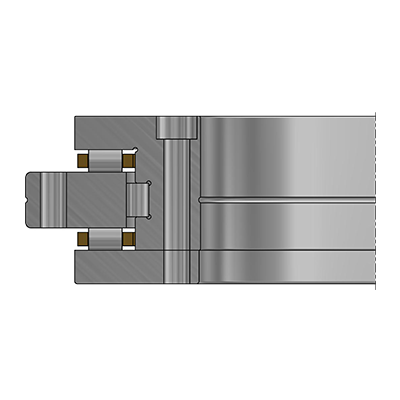
preferred choice for low speeds or low duty cycles. (Example: indexing tables or swivel milling heads)
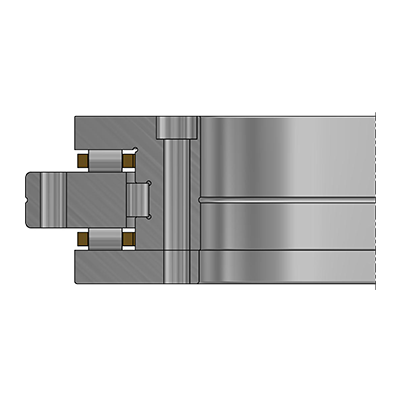
preferred choice for low speeds or low duty cycles. (Example: indexing tables or swivel milling heads)
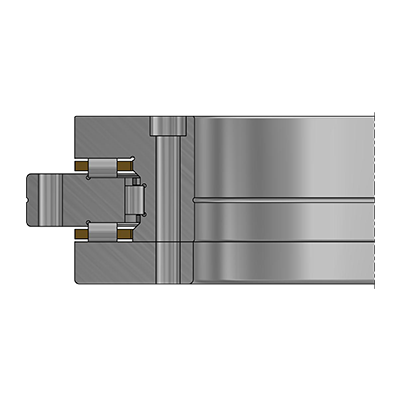
preferred choice for high speeds or directly driven axles. Low friction torque across the entire speed range.
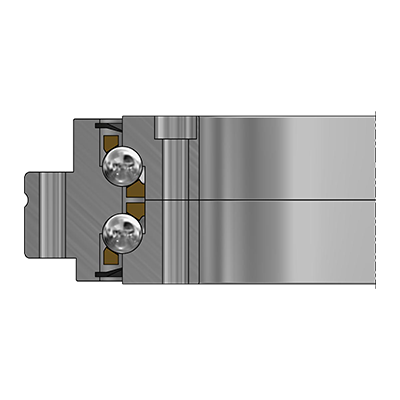
preferred choice for very high speeds and high duty cycles. High tilting stiffness, low friction and low lubricant consumption.
Maintenance instructions and commissioning
Initial commissioning
When first put into operation, rolling bearings can have an increased frictional torque, which can lead to overheating if immediately operated at high speeds. It should be noted that the speed capability, friction and service life of rolling bearings are significantly influenced by the lubricant.
To avoid damage caused by overheating of the bearing, we recommend a running-in cycle, particularly for axial-radial bearings and axial angular contact ball bearings, which is carried out while monitoring the temperature. The bearing ring temperature of +60 °C should not be exceeded.
At low speeds or a short duty cycle, a running-in cycle can be omitted.
Relubrication
Lubrication quantities and lubrication intervals depend on various factors. We cannot give a general recommendation and therefore ask you to ask our technical customer service. Incorrect relubrication without taking into account the load spectrum (duty cycle, speed, load)
and the ambient conditions can seriously damage the bearing during operation, as there is a risk of under- or over-lubrication. After over-lubrication, the bearing can be irreparably damaged by overheating as a result of the increased friction torque when operating at high speeds. The original friction torque
(if no damage has already occurred) can only be restored by a new running-in cycle.
 DE
DE  EN
EN