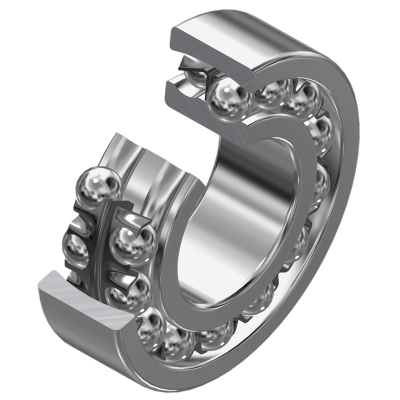
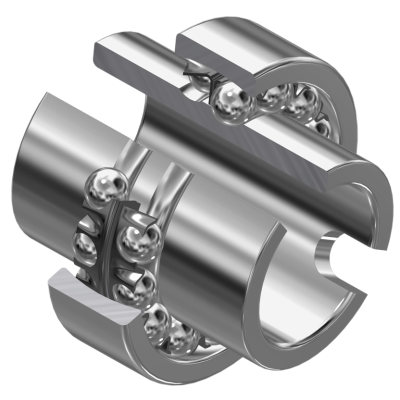
Self-aligning ball bearings - main dimensions according to DIN 617, DIN 630, ISO 15:1998
Self-aligning ball bearings have two rows of balls with two raceways on the inner ring and a common hollow spherical raceway in the outer ring. This means they are angularly movable and insensitive to misalignment of the shaft in relation to the housing. Self-aligning ball bearings are therefore particularly suitable for bearing cases where larger shaft deflections or misalignments are to be expected.
Self-aligning ball bearings are available in versions with cylindrical and tapered bores. They are manufactured in an open basic design, as sealed bearings and bearings with a wide inner ring. The sealed bearings allow operating temperatures from -30°C to +110°C and are filled with a lithium soap grease. Depending on the size and bearing series, self-aligning ball bearings are manufactured with a sheet steel cage, a solid brass cage or a cage made of glass fiber reinforced polyamide 66. The cage can be either one-piece or two-piece. The main dimensions of the bearings correspond to the information in DIN 630 or DIN 617 as well as ISO 15:1998
Self-aligning ball bearings - Bearing properties
- Compensation of fixed and rotating misalignments
- Very good torque characteristics even at high speeds.
- Low maintenance effort
- Low friction due to loose fit between the ball and the outer ring
- Low noise
Self-aligning ball bearings - Series
Self-aligning ball bearing 1200 series, execution with cylindrical bore and conical bore.
Self-aligning ball bearing 1300 series, execution with cylindrical bore and conical bore.
Self-aligning ball bearing 2200 series, execution with cylindrical bore and conical bore.
Self-aligning ball bearing 2300 series, execution with cylindrical bore and conical bore.
Self-aligning ball bearing 11200 series, Version with wide inner ring.
 DE
DE  EN
EN